Paphos Glass Processing: How to Build a Trade Hub
What is the opportunity beyond another glazing business?
The opportunity is to process glass for the trade, not compete with local installers for window-fitting work. A Paphos hub could supply made-to-order insulating glass units, accurately machined panels and selected specialist finishes to businesses that already own the customer relationship.
Its customers would include glazing firms, aluminium fabricators, developers and hotel renovation contractors across western Cyprus. They would buy reliable production slots, documented specifications and careful delivery, rather than another installation service.
The potential benefits are practical: shorter replacement times, fewer transport-related breakages and small orders that receive proper attention. These are investment hypotheses, not established local market facts. Existing processing capacity, purchasing routes and actual delivery performance must be checked first.
A clear trade-only policy matters. Contractors are more likely to share repeat orders with a supplier that will not approach their end customers for installation work.
Why investigate Paphos now?
Paphos is worth investigating because renovation and replacement work can reward local responsiveness, even without a large new-build pipeline. A damaged hotel shower panel, a failed sealed unit or a revised partition specification creates a different purchasing problem from a bulk order of standard glass.
Local production might make these jobs easier to coordinate. However, proximity alone does not guarantee lower costs or faster completion. Glass availability, outsourced processing, factory scheduling and delivery routes all affect the result.
Before buying machinery, interview local glazing contractors and procurement teams. Ask for recent orders or anonymised invoices rather than general expressions of interest:
- Which products come from elsewhere in Cyprus or overseas?
- What are the quoted and actual lead times?
- Which dimensions, finishes or quantities attract minimum charges?
- How often do breakage, incorrect specifications or replacements cause delays?
- What paid monthly volume would buyers commit to a local supplier?
Compare those answers with existing processors' capabilities and quotations. The strongest evidence is repeat purchasing commitment, not enthusiasm for the concept.
Which glass processing services should come first?
Start with the narrowest service range that solves a verified purchasing problem and attracts repeat trade orders. The five opportunities below need different equipment, skills and levels of working capital.
Made-to-order insulating glass units
Local sealed-unit assembly could serve replacement windows, renovation projects and specified low-emissivity upgrades. An initial operation could purchase appropriately processed panes and concentrate on assembly, sealing, quality control and dispatch.
That reduces premature machinery investment, although supplier lead times still matter. Spacer systems, sealant compatibility, moisture control and warranty performance need disciplined management.
Estimated screening gross margin: 20% to 35%, before premises overhead, finance, depreciation and tax.
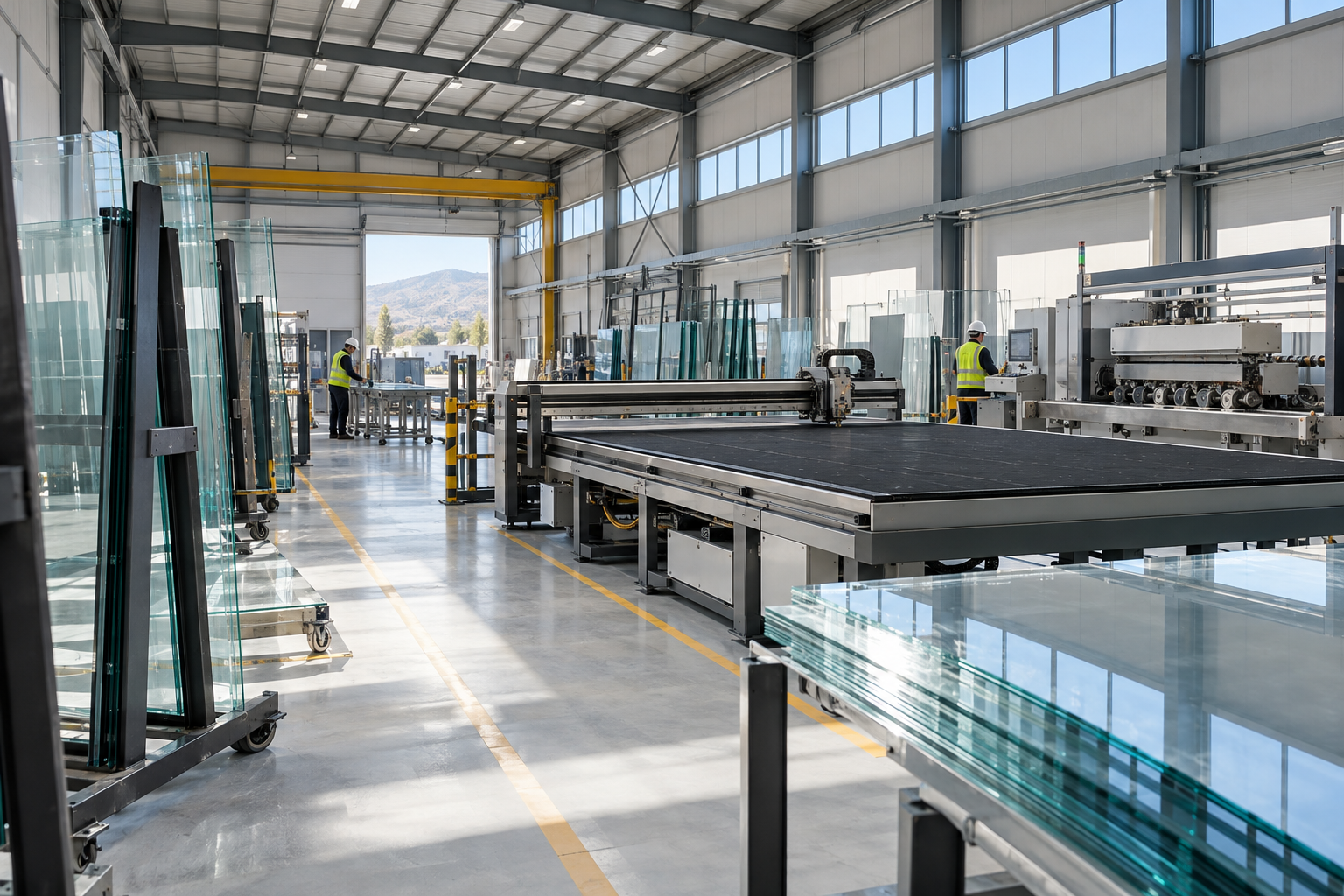
Trade cutting, edge polishing and CNC machining
Cutting, polished edges, holes and cut-outs could support shower screens, counters, partitions and specified balustrade panels. Charge separately for setup, machining complexity and minimum jobs instead of relying only on a price per square metre.
Efficient sheet nesting and repeat accounts help control waste. All machining on glass that will be toughened must take place before toughening, with an agreed external processing route if no furnace is installed.
Estimated screening gross margin: 30% to 45%, before premises overhead, finance, depreciation and tax.
Regional glass toughening
A toughening furnace should generally be assessed as a later expansion unless contracted regional demand supports it from the outset. Establish where western Cyprus businesses currently send glass and how much paid volume they would transfer.
Electrical infrastructure, furnace utilisation and underfilled batches can dominate the economics. Being closer to customers does not compensate for running expensive equipment without enough orders.
Estimated screening gross margin: 20% to 35% at commercially viable utilisation, before premises overhead, finance, depreciation and tax.
Custom laminated safety glass
Small-batch laminated products may suit specified entrances, partitions, acoustic applications and appropriately engineered balustrades. Select a narrow product family rather than promising every thickness and interlayer combination.
Controlled processing conditions, testing and traceability are essential. Structural applications require appropriate engineering and product specifications, not simply thicker glass or a premium selling price.
Estimated screening gross margin: 25% to 40%, before premises overhead, finance, depreciation and tax.
Decorative and privacy finishing
A focused finishing service could supply hotel bathrooms, restaurant partitions and commercial interiors. Samples, repeatable appearance and replacement-panel consistency may be more valuable than an extensive catalogue.
Begin with one proven process. Ceramic printing requires compatible firing capability, while other coatings must suit the intended exposure, cleaning regime and application.
Estimated screening gross margin: 30% to 50%, before premises overhead, finance, depreciation and tax.
What could the rough profit figures look like?
Gross profit may look attractive, but it is not operating profit or an investment return. The following are illustrative estimates using the screening margins above, not forecasts based on verified Paphos orders.
- Insulating glass units: estimated monthly sales of EUR 40,000 to EUR 60,000 at estimated gross margins of 20% to 35% imply approximately EUR 8,000 to EUR 21,000 in gross profit.
- Cutting and machining: estimated monthly sales of EUR 25,000 to EUR 40,000 at estimated gross margins of 30% to 45% imply approximately EUR 7,500 to EUR 18,000 in gross profit.
- Decorative finishing: estimated monthly sales of EUR 15,000 to EUR 25,000 at estimated gross margins of 30% to 50% imply approximately EUR 4,500 to EUR 12,500 in gross profit.
These ranges combine the lower sales and margin assumptions at one end and the higher assumptions at the other. They are separate examples, not revenues to add together automatically.
Cost direct materials, production labour, production energy, consumables, subcontract processing and expected rejects consistently. Then deduct premises overhead, administration, insurance, finance and depreciation to understand operating viability. Allow for warranty claims, customer credit terms and cash tied up in glass stock.
How might trade customers use the hub?
The most useful early customers are businesses with recurring, awkward orders that standard supply arrangements handle poorly. These illustrative scenarios describe possible service models, not actual customers or proven results.
Illustrative scenario: hotel bathroom replacements
A Paphos hotel renovation contractor needs replacement shower panels with accurately positioned holes. The hub checks the approved drawings, cuts and machines the glass, then sends it to an established toughening partner.
The contractor retains installation responsibility. The hub earns processing revenue and coordinates quality checks and delivery. Its value depends on the complete turnaround, including outsourced toughening, rather than its Paphos address alone.
Illustrative scenario: a glazing firm's sealed-unit orders
A local glazing company groups unusual replacement sizes into a regular order. The hub assembles insulating glass units from purchased processed panes and schedules a delivery route around agreed installation dates.
The installer avoids investing in an assembly line. The processor gains repeat volume, provided dimensions, specifications, acceptance checks and warranty responsibilities are clearly documented.
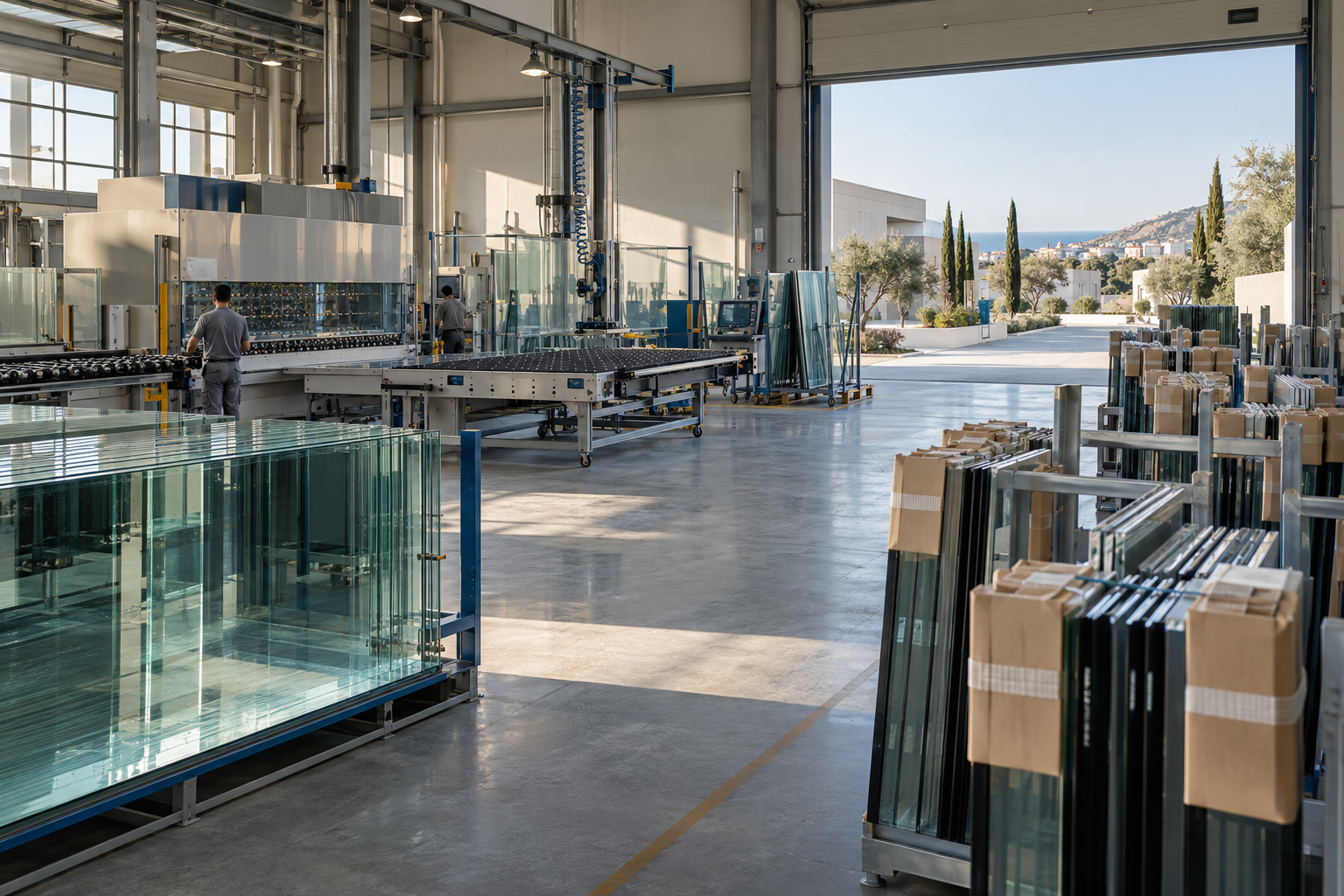
What must a purpose-built glass facility include?
A suitable glass factory needs safe material movement, verified utilities and room for its actual production sequence. A large floor area alone does not make a plot or building suitable.
Plan the route from unloading to storage, cutting, processing, inspection and dispatch before finalising the building footprint.
- Glass storage: engineered racks, suitable floor loading and protected handling zones.
- Truck access: safe entry, turning and unloading without conflicting pedestrian routes.
- Handling equipment: suitable lifting systems, clear heights and door openings.
- Electrical supply: verified available capacity and costed upgrades for the selected machines.
- Water and waste: arrangements for washing, recirculation where appropriate, grinding residue and glass offcuts.
- Controlled areas: clean conditions for insulating-unit or laminated-glass processes.
- Expansion space: a layout that can accept another line without blocking dispatch.
Obtain process-specific advice on Cyprus planning, building, fire, occupational safety and environmental requirements. For relevant EU construction products, confirm applicable standards, testing, factory production control, declarations and CE-marking obligations. Planning designation alone is not permission for every glass process.
Which Anatoliko plots fit the five ideas?
Five available Domenica Group plots offer useful starting points for feasibility studies, but none should be treated as a pre-approved glass factory site. These are freehold plots in Anatoliko, Paphos, with the supplied sizes and asking prices below.
The estate's stated access is approximately 1 minute to the Limassol to Paphos highway, 10 minutes to Paphos airport and 5 minutes to Paphos, depending on route and traffic. For glass operations, truck access to customers and suppliers matters more than airport proximity.
E12 and E13: heavier processing studies
- E12: 1,000 m2, EUR 230,000 + VAT, heavy/industrial zone, available. A candidate for trade cutting, polishing and CNC machining, subject to layout, permissions and utility checks.
- E13: 1,000 m2, EUR 240,000 + VAT, heavy/industrial zone, available. A candidate to investigate for a later toughening operation or heavier processing facility. Furnace dimensions, electrical demand and vehicle circulation may require more land.
E23 and E36: focused first-phase operations
- E23: 1,000 m2, EUR 210,000 + VAT, light industrial/commercial zone, available. Worth assessing for a limited decorative or privacy finishing operation, provided the specific process is permitted and environmental requirements are manageable.
- E36: 1,042 m2, EUR 219,000 + VAT, light industrial/commercial zone, available. Worth assessing for insulating-glass assembly using purchased processed panes, with a layout that protects clean production and dispatch areas.
E58: specialist assembly and handling space
- E58: 1,280 m2, EUR 295,000 + VAT, light industrial/commercial zone, available. Its larger land area makes it worth investigating for specified laminated-glass assembly, controlled rooms and material handling. Equipment, process permissions and engineering remain decisive.
The estate's stated planning parameters are Ba5/Bd5 zoning, 80% building density, 60% coverage and two floors. Confirm the designation and conditions applicable to each plot. Maximum allowances are not guaranteed usable production space: setbacks, access, parking and servicing reduce layout flexibility.
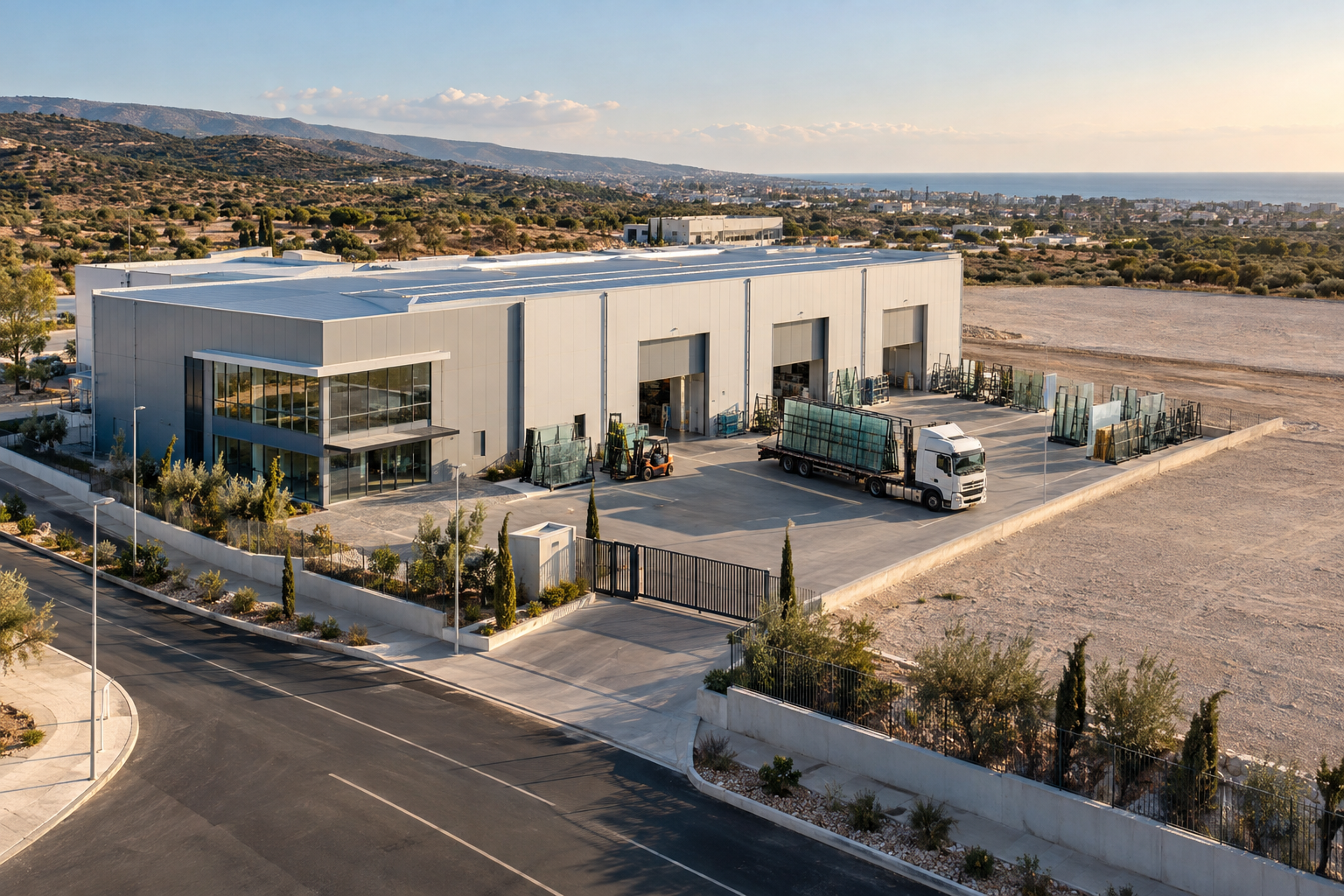
When should investors combine adjacent plots?
Combining adjacent plots can make sense when a single parcel cannot safely accommodate production, storage and truck circulation. Glass facilities can run out of useful yard space before they run out of theoretical building allowance.
A larger site could separate incoming sheets from finished products, retain expansion space or accommodate a future furnace without rebuilding the dispatch area. It may also support a clearer separation between customer collection and heavy deliveries.
Domenica Group plots can be combined, but confirm adjacency, availability and the applicable planning arrangements on the estate plan. Consecutive plot codes do not establish adjacency. Price the combined land, building, utility works and equipment as one project before deciding whether expansion space is worth buying immediately.
How do you move from an idea to a tailored offer?
Begin with verified trade demand and a process-led site brief, then match the land to the business. Gather sample orders, supplier quotations and potential customer commitments before fixing the machinery list.
Share your details, intended glass products, expected production needs and preferred expansion approach with a Domenica Group specialist. The team can help you assess suitable Anatoliko plots, check potential combinations and prepare a tailored quotation and offer for your Paphos industrial project.
Plots that fit this idea
Frequently asked questions
Could Paphos support a trade-only architectural glass processing hub?
Potentially, if glazing firms and contractors commit enough repeat orders at workable prices. Existing local processing capacity, purchasing routes, lead times and minimum order charges need verification before describing the opportunity as a proven market gap.
Which glass processing services should a new business start with?
Assess cutting, edge polishing, CNC machining or insulating-glass assembly using purchased processed panes first. Choose the service supported by verified customer demand, and outsource specialist stages where that avoids premature equipment investment.
Should a Paphos glass factory install a toughening furnace immediately?
Not unless contracted demand, electrical capacity and a detailed cost model support it. A furnace introduces substantial equipment and infrastructure commitments, while underfilled production runs can weaken profitability. All cutting and machining must occur before toughening.
Which Anatoliko plots are worth considering for glass processing?
E12 and E13 are heavy/industrial options worth assessing for machining and heavier processing. E23, E36 and E58 are light industrial/commercial options worth investigating for selected finishing or assembly processes. Each requires confirmation of permitted use, utilities and a safe factory layout.
Can industrial plots be combined for a larger glass facility?
Yes, Domenica Group plots can be combined, subject to confirming adjacency, availability and planning arrangements. A combined site may provide better storage, truck circulation and future production space. Plot numbering alone does not confirm adjacency.