Cleaning Product Manufacturing in Paphos: A Guide
What is the opportunity in cleaning product manufacturing in Paphos?
The opportunity is to blend professional cleaning concentrates locally, rather than simply import and distribute finished liquids. A focused facility in Anatoliko, Paphos, could supply repeat-use products to hotels, restaurants, commercial laundries and vehicle fleets across western Cyprus.
This is not an empty market. Paphos already has cleaning-product suppliers, and established distributors may offer competitive pricing, reliable deliveries and strong technical support. Some suppliers may also blend locally or source from manufacturers elsewhere in Cyprus. The gap to investigate is useful local manufacturing capacity, not an absence of competition.
A small hub would typically buy ingredients, blend approved formulations, check batches and fill professional containers. Concentrates can reduce the volume delivered per cleaning task, while returnable packaging may reduce repeated container purchases. Neither advantage automatically produces a profitable business.
The strongest proposition is practical: consistent performance, transparent dosing costs and dependable replenishment. Customers need fewer operational headaches, not simply another chemical catalogue.
Why investigate Paphos now?
Paphos is worth investigating because several local customer groups consume cleaning products repeatedly, creating a potential base for scheduled production and delivery. Hotels and restaurants provide one route to market; laundries, rental fleets, garages and workshops broaden it.
That does not establish an unmet need or prove that demand is growing. Hotel-related orders can be seasonal, and established supply contracts may be difficult to displace. A balanced customer mix is more credible than a forecast built entirely around peak-season hospitality.
Domenica Group's freehold industrial plots in Anatoliko offer a location for assessing this model. Indicative travel times are approximately one minute to the Limassol to Paphos highway, ten minutes to Paphos airport and five minutes to Paphos, depending on destination and traffic. For this business, road access and efficient delivery rounds are likely to matter more than airport proximity.
Cyprus also operates within the EU regulatory framework. That provides a defined compliance context, but a small manufacturer still needs specialist advice and an adequate compliance budget.
What should investors validate before buying land?
Investors should validate purchasing volumes, incumbent pricing and existing blending operations before committing to a site. Start with customer evidence, not machinery quotations.
Ask procurement managers and operational staff for:
- Monthly consumption by product, including quieter trading periods.
- Current prices, dilution rates and actual cost per wash or cleaning task.
- Contract terms, dispenser ownership and servicing obligations.
- Delivery frequency, storage constraints and emergency replenishment needs.
- Experience with concentrates, refill systems and container returns.
- Willingness to undertake paid trials and agree minimum purchases.
Then map suppliers serving Paphos and other parts of Cyprus. Identify who imports finished products, who blends, and who already provides comparable technical support. Public product catalogues alone will not reveal manufacturing capacity or contract pricing.
A credible investment case starts with a specific customer problem and evidence that customers will pay to solve it.
Which cleaning products could a small Paphos hub make?
A sensible starting range covers a few non-disinfectant products with repeat demand and manageable production requirements. Outsourced formulation expertise can reduce early development costs, although the manufacturer remains responsible for compliance and product quality.
Commercial laundry detergent and separate boosters
Laundry blending could serve commercial laundries and hotel laundry operations with detergent and separate boosters matched to their wash processes. Validate wash volumes, fabric requirements, measured water conditions and compatibility with dosing equipment.
The potential advantage is smaller minimum orders and responsive replenishment. Existing distributors may already deliver excellent technical support, so paid trials must demonstrate a measurable benefit. Begin with a narrow range rather than an expensive laboratory and numerous bespoke recipes.
Professional dishwasher detergent and rinse aid
Dishwasher chemistry could support recurring restaurant and hotel-kitchen supply agreements. The useful comparison is cost per successful wash, including dosing and servicing, rather than container price alone.
Measure water conditions and test cleaning performance before selecting formulations. Check whether customers are tied to equipment or supply contracts. Free dispensers can consume early profit, making paid trials and minimum purchase commitments important before expanding capacity.
Hotel housekeeping concentrates
A standardised range of floor, glass and bathroom cleaners could suit nearby properties willing to adopt common products and controlled dilution. Confirm whether incumbent suppliers already offer equivalent concentrates, training and refill logistics.
Returnable containers require collection schedules, inspection, cleaning procedures and traceability. The facility needs separate areas for clean filling and returned-container handling. Container deposits protect the packaging pool; they are not operating profit.
Fleet and workshop cleaning chemicals
Non-disinfectant vehicle shampoos and water-based degreasers could serve rental fleets, bus operators, garages and agricultural workshops. This creates a customer base beyond hotel housekeeping.
Test compatibility with paint, metals, seals and other relevant surfaces. Customers also need lawful wash-water disposal arrangements. Bulk formats and fast repeat supply may be useful, but established brands can compete aggressively on price. Import availability alone does not establish a market gap.
What could the gross margins look like?
Illustrative gross-margin estimates range from roughly 20% to 45%, depending on the product category and operating model. These are planning estimates, not verified Paphos trading results or promised returns.
For a simple comparison, assume hypothetical monthly sales of EUR 20,000 excluding VAT for one product line:
- Laundry detergent and boosters: estimated gross margin of 20% to 35%, producing approximately EUR 4,000 to EUR 7,000 gross profit.
- Dishwasher detergent and rinse aid: estimated gross margin of 25% to 40%, producing approximately EUR 5,000 to EUR 8,000 gross profit.
- Housekeeping concentrates: estimated gross margin of 30% to 45%, producing approximately EUR 6,000 to EUR 9,000 gross profit.
- Fleet and workshop products: estimated gross margin of 25% to 40%, producing approximately EUR 5,000 to EUR 8,000 gross profit.
These examples deduct ingredients, containers and direct production costs. They are alternatives, not a combined sales forecast. Delivery, collection routes, dosing support, dispenser servicing, technical sales, compliance, premises overhead and financing still need to be covered where not included in direct costs.
Model seasonal sales, customer payment delays, rejected batches and container losses. Land purchase and factory construction require a separate capital budget. Attractive gross margins do not establish net profitability or an investment payback period.
What might an early customer trial look like?
An early trial should test cleaning performance, service costs and customer willingness to reorder before the business scales. The following are illustrative scenarios, not actual Paphos businesses or reported results.
Illustrative scenario: a hotel housekeeping cluster
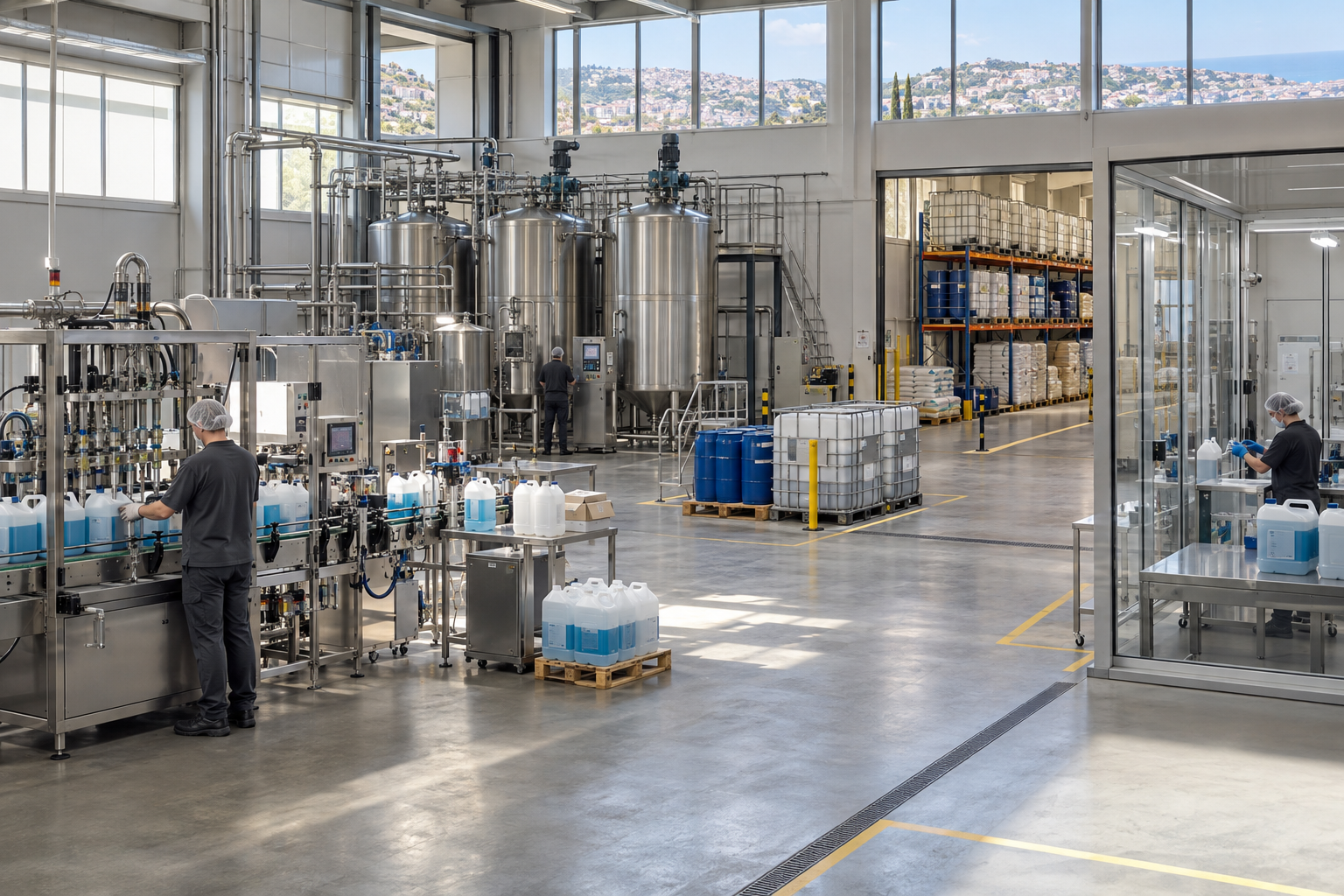
A prospective producer trials a small standardised range with nearby hotels. Staff receive dilution training, and containers are collected during scheduled deliveries. The trial tracks consumption per cleaning task, cleaning results, returns and delivery time.
If customers need frequent emergency visits or return containers in poor condition, the apparent packaging saving may disappear. Expansion depends on paid repeat orders and a workable collection route.
Illustrative scenario: laundry and fleet accounts
Another operator tests laundry detergent with a commercial laundry while offering vehicle shampoo to rental-fleet operators. Separate formulations and handling procedures support the different applications.
The aim is to assess whether different customers can support steadier utilisation across the year. That benefit must be demonstrated through order patterns, not assumed simply because the customer sectors differ.
What approvals and site features would production need?
The site would need approval for its specific chemical-production activities, alongside safe storage, delivery access, spill containment and compliant wastewater arrangements. An industrial-zone description is not automatic permission to manufacture every cleaning formulation.
Before purchase, obtain professional advice and confirmation from the relevant Cyprus authorities on:
- Permitted manufacturing, storage and filling activities.
- Environmental, fire-safety and occupational-safety requirements.
- Compatible chemical storage, ventilation and secondary containment.
- Controlled drainage, spill isolation and separation from stormwater.
- Treatment, authorised discharge or licensed collection of process wastewater.
- Waste handling, container cleaning and emergency procedures.
EU product obligations may include REACH, CLP classification and labelling, applicable detergents legislation and safety data sheets. UFI and poison-centre notification requirements may apply to hazardous mixtures. Requirements depend on the formulation, classification, supply arrangements and intended use.
Start with non-disinfectant products and avoid disinfectant claims. Products marketed for biocidal purposes can trigger additional requirements under the EU Biocidal Products Regulation. Ordinary detergents still require appropriate compliance, batch records, quality checks and safe-use information.
Do not assume container-washing water or production residues can enter a normal drain. Resolve the wastewater route before finalising the layout or equipment order.
Which Anatoliko plots could fit each idea?
Four available heavy/industrial-zone plots provide useful starting points for feasibility discussions, subject to approval of the specific production use. These are conditional shortlist suggestions, not confirmed chemical-manufacturing sites.
- E12: 1,000 m², EUR 230,000 + VAT. A candidate for laundry detergent and booster blending, with a layout assessing ingredient storage, blending, filling and dispatch.
- E15: 1,000 m², EUR 230,000 + VAT. A candidate for dishwasher detergent and rinse aid, subject to safe segregation of incompatible materials and space for technical-service stock.
- E16: 1,000 m², EUR 240,000 + VAT. A candidate for housekeeping concentrates, provided clean filling and returned-container handling can be properly separated.
- E17: 1,000 m², EUR 250,000 + VAT. A candidate for fleet and workshop products, subject to suitable bulk-delivery access, containment and loading arrangements.
These plots are all listed as available. Their identical areas do not prove identical operational suitability, and the price differences should not be interpreted as verified technical advantages.
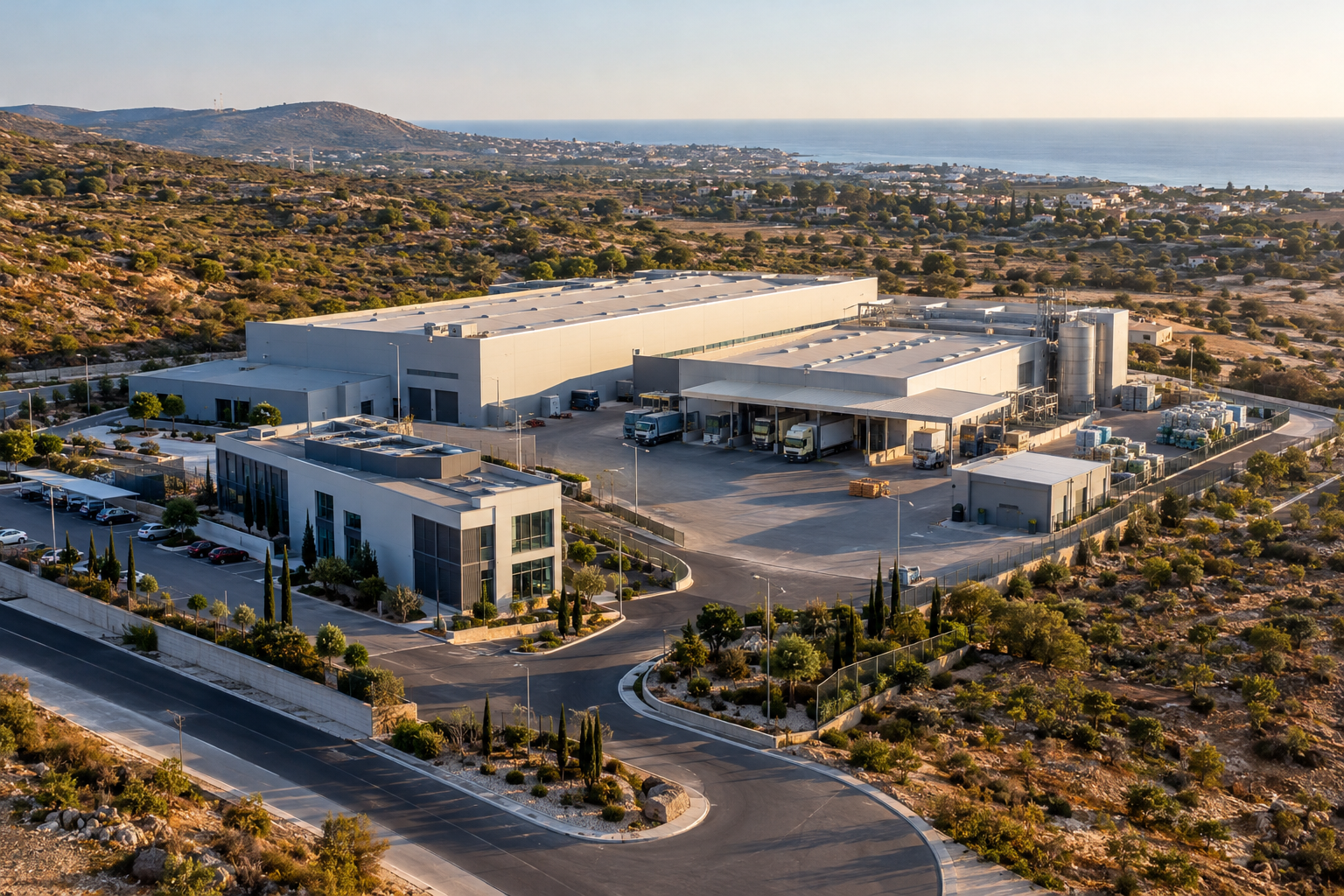
The estate's stated Ba5/Bd5 planning parameters are 80% density, 60% coverage and two floors. Confirm the designation and applicable conditions for the selected plot. Setbacks, parking, loading, fire access and process requirements determine the practical building layout.
When does combining adjacent plots make sense?
Combining adjacent plots can make sense when a single parcel cannot comfortably accommodate production, storage, returns and vehicle circulation. It is worth exploring for a larger hub or a phased expansion backed by customer commitments.
Additional space could separate incompatible materials, create dedicated container-return handling and reserve room for future filling equipment. It may also improve delivery access without crowding production areas.
Domenica Group offers the option to combine plots, but confirm actual adjacency, availability, access and planning treatment before designing a combined facility. Consecutive plot codes are not proof of adjacency. Compare the full cost of a larger site with the operational constraints of a smaller one.
How do you take the next step?
The next step is to turn customer evidence into a site brief, then match that brief to a plot with a credible approval pathway. Include intended products, likely throughput, storage needs, delivery vehicles, wastewater arrangements and expansion plans.
Local blending in Paphos deserves investigation where it can improve performance, replenishment or packaging logistics. Share your details and project requirements with a Domenica Group specialist for a tailored quotation and offer, including suitable available plots and potential combination options, subject to technical and regulatory checks.
Plots that fit this idea
Frequently asked questions
Is there a gap for cleaning product manufacturing in Paphos?
There may be an opportunity for local blending, but it has not been established here. Paphos already has suppliers, and investors should investigate existing blending operations, customer volumes, incumbent pricing and service contracts before buying land.
Which cleaning products should a small Cyprus manufacturer start with?
A narrow range of non-disinfectant laundry detergents, dishwasher products, housekeeping concentrates or vehicle cleaners is worth testing. Choose the starting range through paid customer trials and formulation advice, rather than launching all four categories at once.
Does an industrial plot automatically permit cleaning chemical production?
No. The specific manufacturing, storage and filling activities must be acceptable under the plot's planning conditions and relevant Cyprus requirements. Confirm chemical-use approval, fire safety, containment and wastewater arrangements before committing to the purchase.
What margins could a cleaning product blending business achieve?
The article uses illustrative gross-margin estimates of approximately 20% to 45%, depending on the category. These are not verified Paphos results. Delivery, servicing, sales, overhead, finance and other costs can substantially reduce the amount remaining as net profit.
Which Anatoliko plots are worth assessing for a blending facility?
E12 and E15 are each 1,000 m² at EUR 230,000 + VAT, E16 is 1,000 m² at EUR 240,000 + VAT, and E17 is 1,000 m² at EUR 250,000 + VAT. All are listed as available in the heavy/industrial zone, but suitability for a particular chemical-production process remains subject to technical and regulatory confirmation.