Could Paphos Support a Mineral Recycling Industrial Park?
What is the mineral recycling opportunity in Paphos?
The opportunity is to turn suitable construction waste into dependable building materials, earning from acceptance where commercially achievable and again from product sales. Concrete rubble, excavated stone and road planings can all retain value when they are segregated, processed and matched to an approved use.
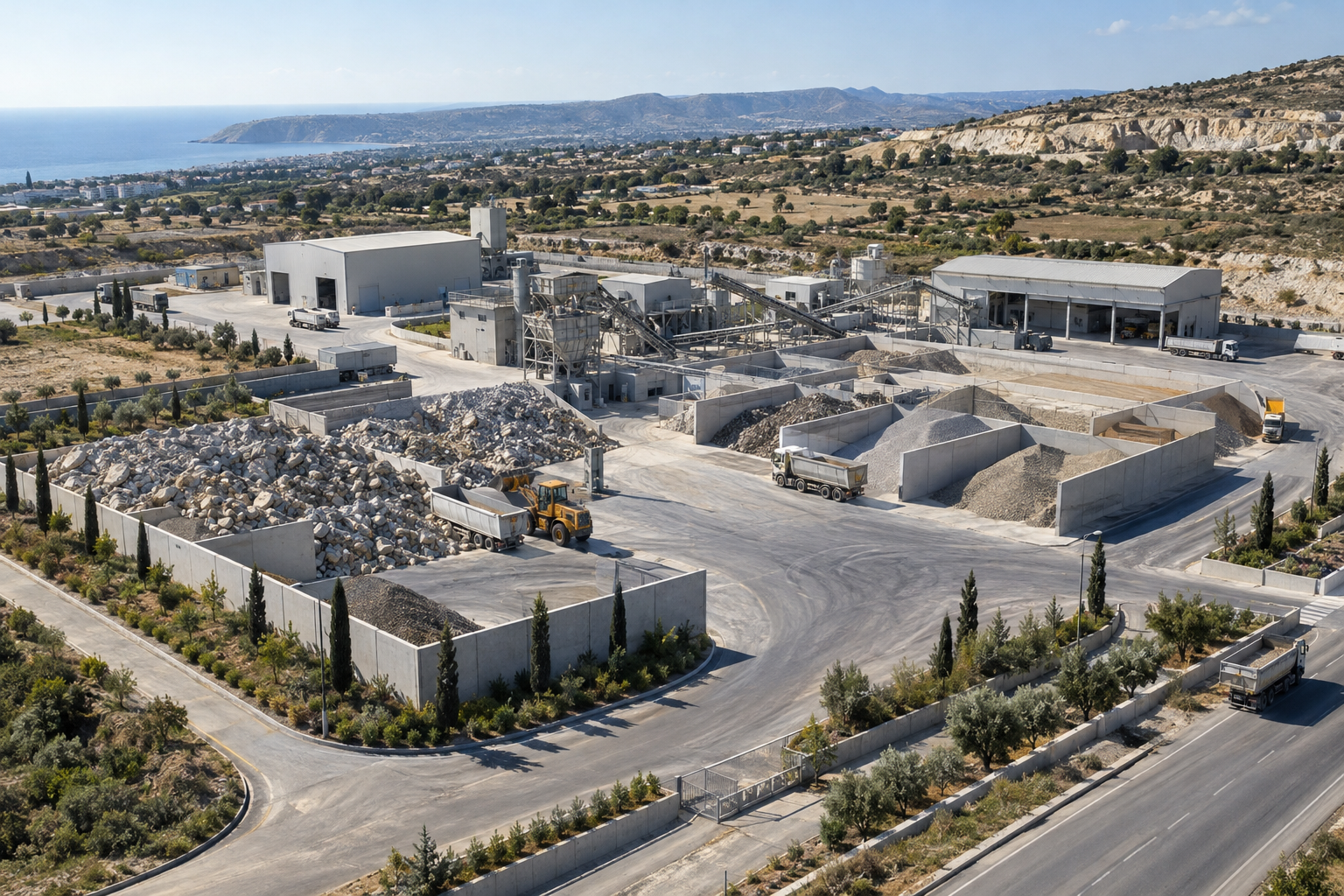
A mineral recycling industrial park could bring several complementary businesses together: an aggregate recovery yard, a stone-screening centre, a precast workshop and a reclaimed-asphalt depot. Shared infrastructure could support separate operators, although permit responsibilities would need to remain clear.
This is not hotel-interior salvage. It involves heavy machinery, frequent truck movements, stockpiles, dust and noise. The right location needs industrial land, workable access and adequate separation from sensitive neighbours.
For Paphos, Cyprus, the proposition is worth investigating. It is not yet a proven market gap.
Why investigate Paphos now?
The reason to investigate now is the potential to shorten local material journeys and improve supply reliability, not an assumption that Paphos has no recyclers. Construction, demolition, excavation and road maintenance can generate mineral streams, while other projects need suitable aggregates and fill.
The EU circular-economy context supports examining recovery before disposal. However, policy direction does not establish local demand or make every recovered material suitable for construction.
Before committing capital, investors should:
- Map existing recyclers, road contractors, their permits and available capacity.
- Interview demolition and excavation contractors about volumes, load quality, prices and journey times.
- Ask civil engineers, asphalt producers and builders which specifications they will accept.
- Check whether any service shortfall reflects seasonal peaks rather than year-round demand.
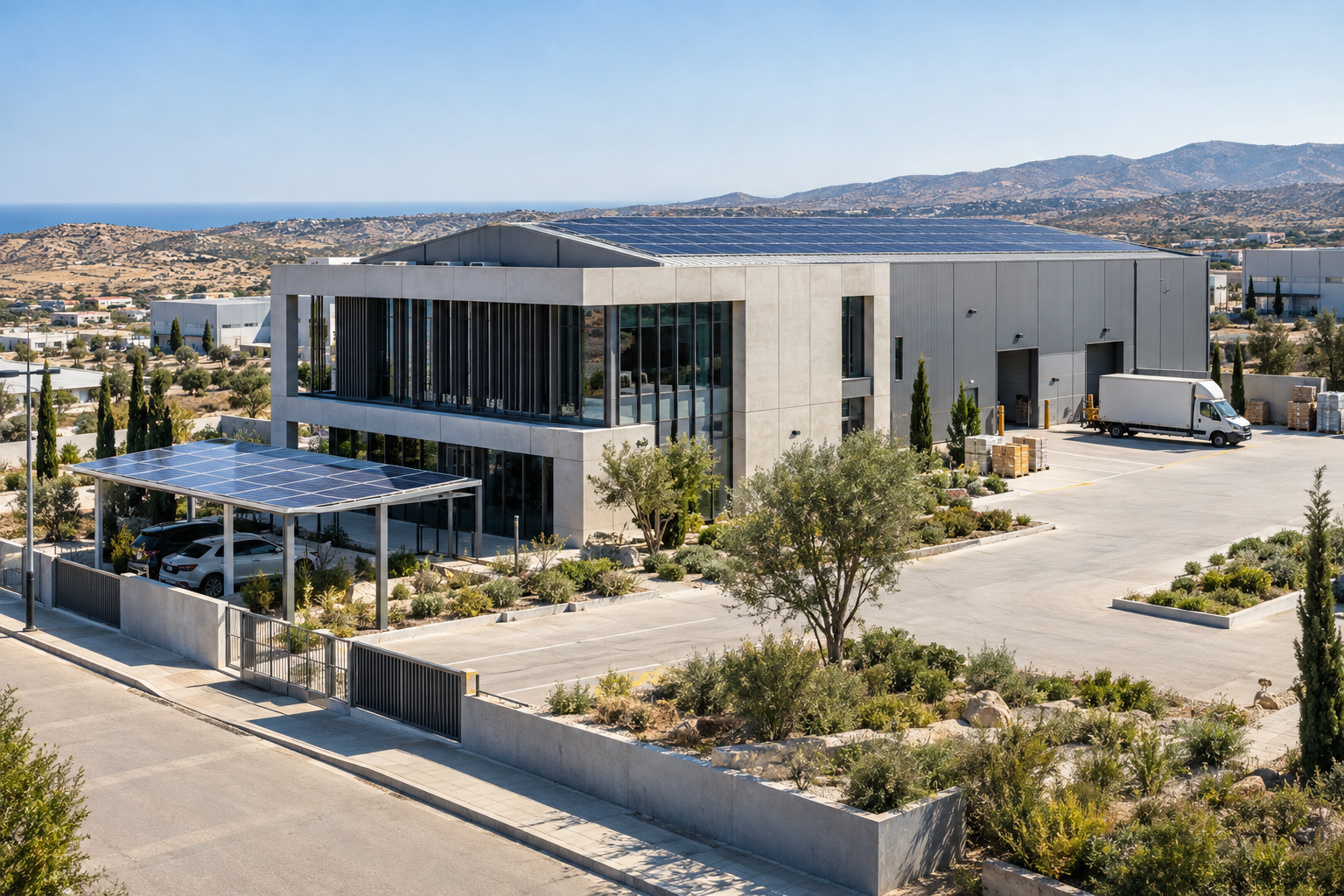
Anatoliko is worth including in that location study. Domenica Group’s indicative travel times are approximately one minute to the Limassol to Paphos highway, five minutes to Paphos and ten minutes to Paphos airport, subject to traffic and route. For mineral processing, practical truck routes matter more than airport proximity.
Which businesses could operate in a mineral recycling park?
Four complementary activities could recover value from different material streams, provided each has suitable permissions, controlled inputs and committed buyers. They should be assessed separately before being combined into one investment.
Could concrete and masonry become saleable aggregate?
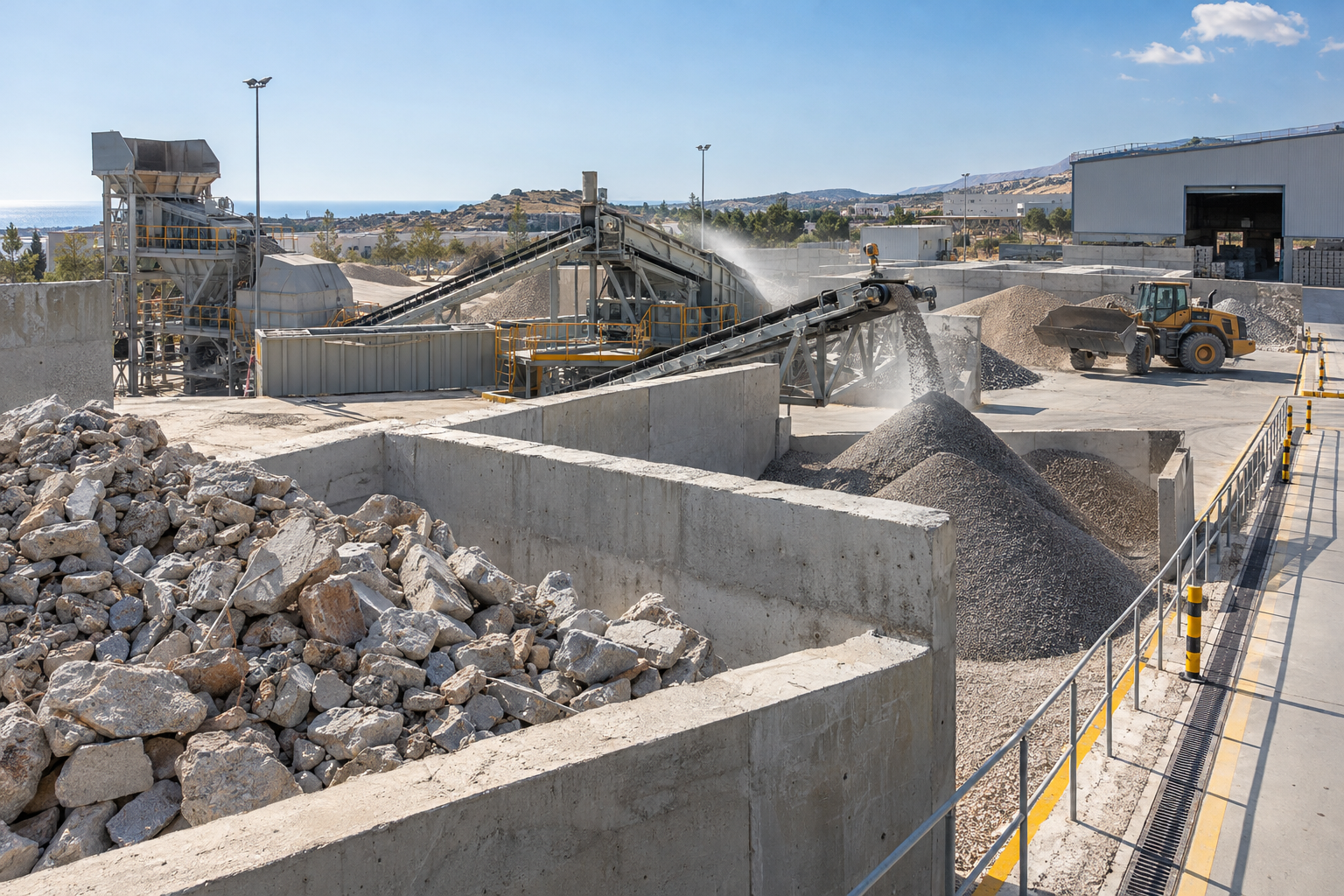
A concrete and masonry aggregate recovery yard would inspect incoming rubble, remove unsuitable material, crush and screen it, and separate finished grades into identifiable stockpiles.
Potential outlets include specified fill and sub-base applications, subject to engineering approval and applicable requirements. Recycled aggregate is not automatically suitable for structural concrete.
Income could combine acceptance fees with aggregate sales. Crushing, screening, loading, testing, dust suppression and rejected-material disposal are major direct costs. Clean incoming loads and short haul distances would be critical.
The local question is whether Paphos contractors need a more dependable outlet offering documented acceptance, predictable turnaround and consistently graded products.
Could excavated stone and soil serve another construction site?
An excavated stone and soil screening centre could connect projects producing suitable excavation material with projects needing compliant stone or fill.
Start with clean, traceable loads. Excavated material is not automatically a product simply because it looks natural. Its classification, contamination status and intended use require checking.
Revenue could come from acceptance, screened-material sales and delivery charges. Testing, handling, transport and rejected loads can quickly absorb the margin.
The service would be valuable if local contractors currently face avoidable hauling or unreliable access to suitable recovered material. That needs verification through contractor interviews and actual quotations, not assumptions.
Could recycled aggregate support a precast workshop?
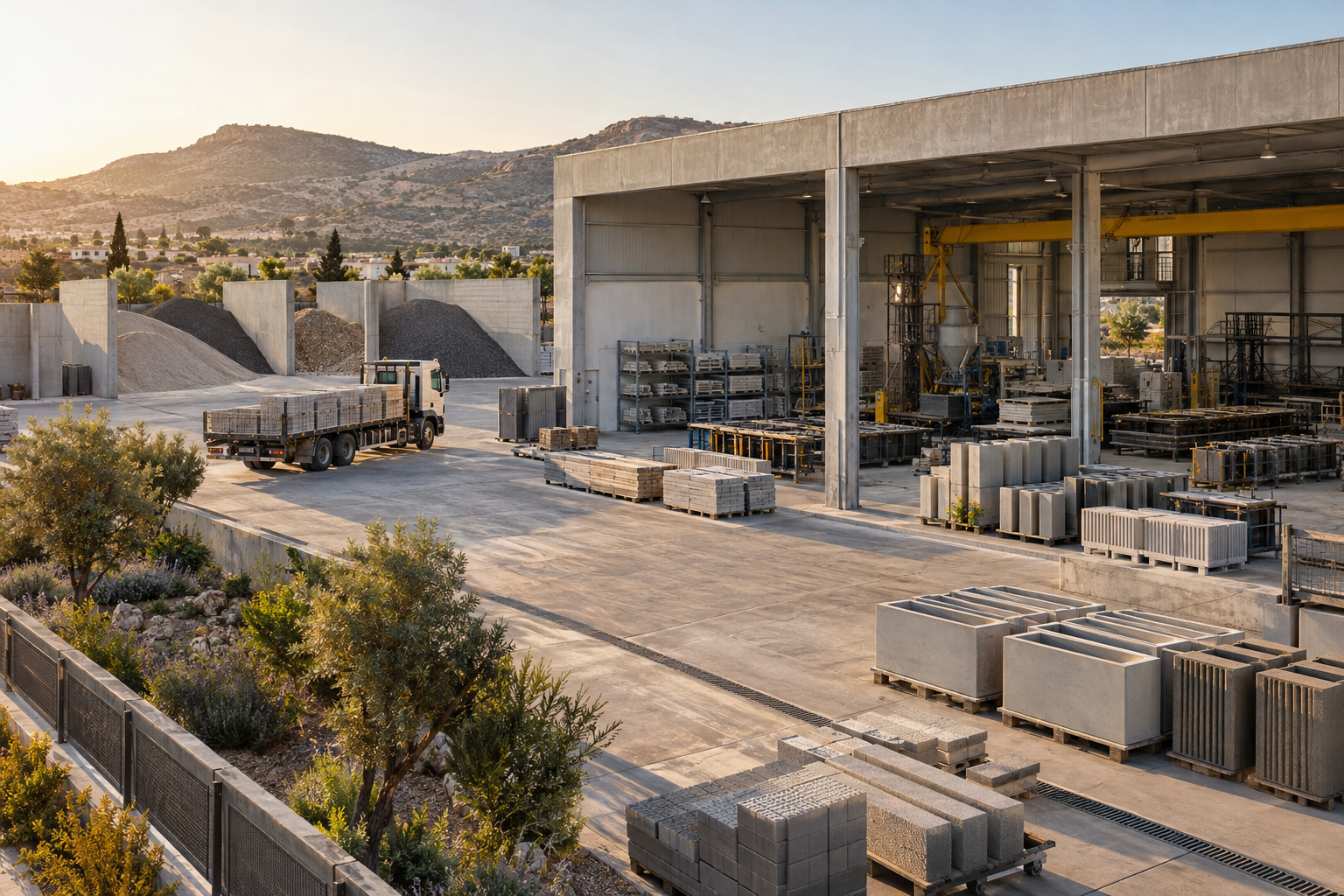
A recycled-aggregate precast workshop could manufacture selected non-structural products using validated recycled aggregate blends.
Yard dividers and landscaping blocks are possible starting points, subject to product-specific design and testing. Non-structural does not mean exempt from quality or safety requirements.
Value comes from producing a useful finished item rather than selling aggregate alone. Cement, moulds, labour, curing space, testing, breakages and delivery all affect profitability.
The gap to test is demand for locally made, short-run products with dependable specifications and delivery. Ordinary concrete suppliers already compete for construction spending, so repeat orders should guide the initial range.
Could road planings supply asphalt producers?
A road planings processing depot could supply consistent reclaimed asphalt feedstock without initially investing in a complete asphalt plant.
Suitable planings would be segregated, checked, processed to an agreed specification and stored under controlled conditions. Suspect or potentially tar-containing material needs specialist assessment and an appropriate authorised route, not routine mixing.
Processing contracts and graded-material sales could generate income. However, road contractors may already recover their own planings internally.
Map those arrangements first. An offtake agreement with an asphalt producer, covering quality, quantities and pricing, should precede major equipment purchases.
What might the rough profits look like?
Illustrative gross-margin targets range from roughly 15% to 40%, depending on the activity, but they are estimates rather than verified Paphos results. The following monthly revenue bands are hypothetical modelling inputs, not measured demand or forecasts.
- Aggregate recovery: Estimated revenue of EUR 40,000 to EUR 60,000 at an estimated 20% to 35% gross margin produces approximately EUR 8,000 to EUR 21,000 gross profit.
- Stone and soil screening: Estimated revenue of EUR 25,000 to EUR 40,000 at an estimated 20% to 35% margin produces approximately EUR 5,000 to EUR 14,000 gross profit.
- Precast products: Estimated revenue of EUR 30,000 to EUR 50,000 at an estimated 25% to 40% margin produces approximately EUR 7,500 to EUR 20,000 gross profit.
- Road planings: Estimated revenue of EUR 30,000 to EUR 50,000 at an estimated 15% to 30% margin produces approximately EUR 4,500 to EUR 15,000 gross profit.
These examples assume sufficient contracted throughput and include the relevant direct operating costs. They are before land costs, financing, depreciation and central overhead, so they are not net returns.
Do not assume every incoming load earns a fee. Valuable clean material may require payment, and processed stock may remain unsold. Model incoming tonnes, saleable yield, rejected material, transport and buyer payment terms separately.
What permissions and site controls would be needed?
Industrial zoning is a starting point, not permission to accept waste or operate crushing equipment. A Cyprus planning and environmental adviser should confirm the specific approval pathway before land or machinery commitments become unconditional.
Key checks include:
- Planning and building requirements for the proposed layout and activity.
- Waste-management permissions, accepted waste categories, quantities and storage limits.
- Environmental assessment or other approvals where applicable.
- Dust, noise, runoff, drainage and groundwater protection measures.
- Product testing, traceability and applicable conformity requirements, including CE marking where required.
- The conditions under which processed waste can legally become a product, where applicable.
A practical layout also needs safe truck turning, pedestrian separation, inspection and quarantine areas, equipment clearances and distinct incoming and finished stockpiles. Sensitive neighbours must be assessed from the actual site, rather than assumed absent because an address is industrial.
Shared facilities may reduce duplicated costs, but the park still needs clear responsibility for acceptance decisions, environmental controls and compliance.
Which Anatoliko plots should investors investigate?
Five listed heavy/industrial plots provide a sensible starting shortlist, subject to activity-specific approvals and a workable site layout. These are freehold land options from Domenica Group, not existing licensed recycling facilities.
- E12: 1,000 m², EUR 230,000 + VAT, available. A candidate component for an aggregate recovery yard, particularly if combined with further land for stockpiles and truck circulation.
- E13: 1,000 m², EUR 240,000 + VAT, available. Worth assessing for stone screening, where segregated storage bays and dispatch space will determine practical capacity.
- E14: 1,000 m², EUR 240,000 + VAT, available. A candidate for a compact precast workshop, subject to sufficient production, curing, storage and loading space.
- E30: 1,000 m², EUR 270,000 + VAT, available. Worth investigating for a road-planings operation if access, controlled storage and environmental requirements can be accommodated.
- E15: 1,000 m², EUR 230,000 + VAT, available. An additional option to assess for processing or expansion, depending on its position relative to the selected site.
These are conceptual allocations, not technical suitability findings. A single 1,000 m² plot should not be assumed adequate for a complete heavy-processing operation.
The estate’s stated Ba5/Bd5 planning parameters are 80% density, 60% coverage and two floors. Confirm the applicable provisions for each parcel. Building allowances do not remove requirements for setbacks, truck routes, stockpiles or environmental controls.
How could the concept work in practice?
A phased operation with contracted material and buyers is more credible than launching every process at once. These illustrative scenarios are not existing projects or reported results.
Illustrative scenario: A contractor-led aggregate yard
Several demolition contractors agree to deliver segregated rubble, while civil-works buyers specify the grades they need. The operator commissions processing only after permissions, acceptance procedures and trial testing are in place.
The advantage is not simply charging twice. It is coordinating incoming material, saleable yield and dispatch so the yard does not become an expensive stockpile. Expansion follows evidence of repeat orders.
Illustrative scenario: A precast workshop buying processed aggregate
An entrepreneur starts with selected landscaping products, purchasing compliant recycled aggregate from an established supplier rather than running an on-site crusher.
This reduces initial processing complexity, although workshop and product requirements still apply. After validating blends and securing repeat customers, the business considers more moulds, curing space or a closer relationship with a permitted recovery yard.
Why consider combining adjacent plots?
Combining adjacent plots can make a heavy-processing layout more practical by creating space for safe circulation and separated material flows. Domenica Group’s plots can be combined, subject to confirming adjacency, availability and the relevant approval arrangements.
As a purchase-price illustration, E12 and E13 together represent 2,000 m² at EUR 470,000 + VAT. This arithmetic does not confirm that the pair is adjacent or suitable for a unified operation. The estate plan and professional advice must establish that first.
A larger footprint could accommodate inspection, processing, finished-product bays and loading without forcing every activity into the same space. It could also support phased development. However, more land is worthwhile only if contracted throughput and the operating plan justify the additional capital.
What should an investor do next?
Start with a local feasibility study and a concept layout, then match the verified operation to the land. Confirm existing capacity, supply contracts, buyer specifications, permissions and delivered costs before treating any projected margin as achievable.
If you are exploring a mineral recycling business in Paphos, share your details, intended activity, space requirements and budget with a Domenica Group specialist. The team can help you review available Anatoliko plots and potential combinations, then prepare a tailored quotation and offer for the land that best matches your brief.
Plots that fit this idea
Frequently asked questions
Could Paphos support a construction waste recycling industrial park?
Potentially, if verified material volumes, buyer demand and permitted capacity support the investment. Existing recyclers and road contractors must be mapped first. The opportunity may be better turnaround, shorter transport routes or more consistent products rather than an absence of local operators.
How does a mineral recycling business make money?
Revenue can combine acceptance or processing fees with sales of recovered aggregate, screened stone, compliant fill or reclaimed asphalt. Fees are not guaranteed, and some clean material may need to be purchased. Profit depends on saleable yield, direct processing costs, transport, rejection rates and reliable buyers.
Does industrial zoning in Cyprus allow concrete crushing automatically?
No. Industrial zoning does not itself authorise waste acceptance or crushing. The proposed operation needs a site-specific review of planning, waste-management and environmental requirements, alongside controls for noise, dust, drainage, traffic and storage.
Is a 1,000 m² industrial plot enough for a recycling yard?
It should not be assumed sufficient for a complete heavy-processing yard. Truck turning, machinery clearances, inspection areas and separate stockpiles can require substantial space. A compact workshop may have different needs, but every proposal requires a professional layout assessment.
Which Domenica Group plots could suit a mineral recycling project?
E12, E13, E14, E15 and E30 are available heavy/industrial plots to investigate, each measuring 1,000 m². Their listed prices range from EUR 230,000 to EUR 270,000 + VAT. Suitability depends on permissions, access, layout and environmental requirements. Any proposed combination also needs confirmed adjacency and availability.